The tricolor looks the same whether it flies over a high-tech international school in Gurgaon or a small government school in a remote village in Vidarbha. The anthem sounds the same. The pride in the students' eyes is the same.
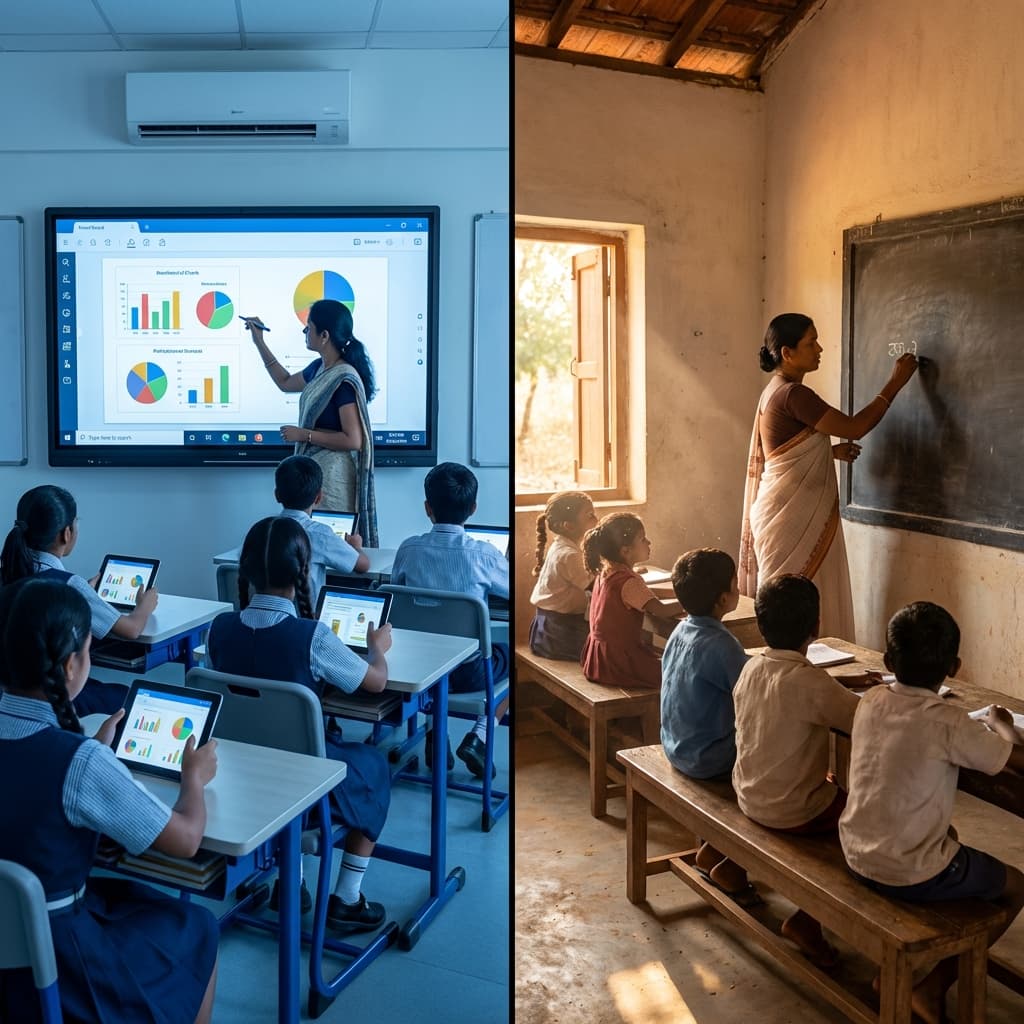
But when the ceremony ends and the students walk back to their classrooms, two very different nations emerge.
The Silence After the Anthem
In one classroom, a smartboard lights up. The world is at their fingertips. A teacher uses real-time data to see exactly who is confused and who is bored. The path forward is clear.
In the other classroom, a teacher stands before a blackboard. She fights a battle with broken chalk and outdated textbooks. She has forty students and forty-five minutes. She wants to help every single one of them, but she is flying blind. She has no way to know what is happening inside their heads until the exam results come out months later. By then, it is often too late.
This is the reality of our Republic in 2026. We have democratized access to schools, but we have not yet democratized access to quality.
"You cannot buy the development of a country. You have to build it."
Beyond the Statistics
We often talk about the "Digital Divide" like it is just a statistic. We read that only 18% of rural schools have internet connectivity compared to nearly 50% in cities. We nod at the fact that while 70% of urban kids use computers, only 20% of rural kids do.
But let us look at what those numbers actually mean.
It means a bright child in a rural district has to work ten times harder just to find the same information a city kid gets in a click. It means a dedicated teacher spends half her time filling out paperwork by hand instead of looking her students in the eye.
It means that despite having the same potential, they are running the same race with vastly different starting lines.
The Problem with the "Business Model"
For years, companies looked at this gap and saw dollar signs. They built "solutions" that were really just products. They sold tablets that gathered dust in locked cupboards. They sold complex software that teachers hated to use. They treated education like a transaction.
They thought about the model. They thought about the revenue. They rarely thought about the impact.
If we want to close this gap, we have to stop viewing schools merely as customers. We have to start viewing them as the foundation of our future. The goal cannot be to extract maximum revenue per user. It must be to extract maximum potential per student.
Technology as a Duty
This Republic Day, we need to make a different kind of promise.
Technology should not be a luxury item. It should be the wind at the back of every student, no matter where they are born. It should be the tool that amplifies the teacher's voice, not replaces it.
At Edulaift, we decided to stop building for the market and start building for the mission. We asked a simple question. What if the technology was invisible? What if it didn't add work, but took it away?
We are building tools that give a village teacher the same superpowers as a city teacher.
- Calculated insights on who is struggling.
- Automated paperwork so she can focus on teaching.
- Personalized help for students who cannot afford private tutors.
Our Pledge
The tricolor stands for courage, peace, and growth.
Today, courage means facing the gap honestly. Peace means giving every child an equal shot at their dreams. And growth means using technology not just to make money, but to make a nation.
To the educators fighting the good fight in every corner of India, we are with you. Technology is no longer optional. It is the infrastructure of the future. And it belongs to you not as a privilege, but as a right.
Jai Hind.
Join the Mission
See how we are bridging the gap for schools across India.